Early Cavity vs. Deep Cavity: Signs, Treatment Options, and Dental Costs
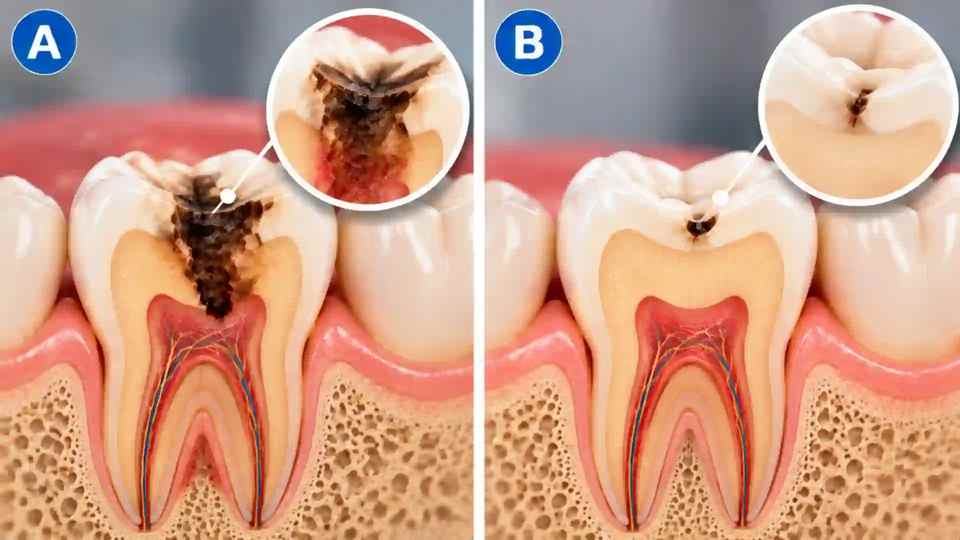
The correct quiz answer is B: Early cavity. Early tooth decay is generally less advanced than a deep cavity, especially when mineral loss has occurred but the enamel surface remains intact. Appropriate fluoride treatment and preventive care may help stop or reverse an early noncavitated lesion.
Key Takeaways:
An early cavity may be stopped or reversed before a physical hole forms.
Early tooth decay often causes no noticeable symptoms.
A deep cavity has progressed farther into the tooth and may extend into dentin or approach the dental pulp.
Fluoride and preventive care can help manage suitable early lesions but cannot rebuild missing tooth structure.
Deep cavities may require a filling, crown, root canal treatment, or another appropriate procedure.
A deep cavity does not automatically require a root canal.
A dental examination is the most reliable way to assess the stage of decay and determine appropriate treatment.
This guide explains the differences between early and deep cavities, how tooth decay progresses, what treatments may be appropriate, and which factors affect dental treatment costs.
Medical information notice: This article provides general educational information and does not diagnose dental conditions or replace advice from a licensed dental professional.
Quiz Answer: Which Tooth Shows a Less Advanced Stage of Decay?
Early cavity is the correct answer because early tooth decay generally involves mineral loss before substantial tooth structure has been destroyed. When the enamel surface remains intact, fluoride and appropriate preventive care may help remineralize the affected area and stop the decay process.
A deep cavity represents more advanced decay. It may extend through the enamel into dentin and approach or affect the dental pulp, which contains nerves and blood vessels.
The distinction matters because treatment depends on how far the decay has progressed. Early noncavitated lesions may be managed with preventive measures, while more advanced damage may require restorative treatment or assessment of the pulp.
Symptoms alone cannot reliably establish the stage of decay. A dentist can examine the tooth and use dental X-rays when appropriate to assess the extent of the lesion.
What Is the Difference Between an Early Cavity and a Deep Cavity?
An early cavity is an informal term that can refer to an early tooth decay lesion before a physical hole has formed. The more precise clinical term for this stage is an early noncavitated caries lesion.
At this stage, minerals have been lost from the enamel, but the surface may remain intact. A chalky white spot can sometimes appear, although early decay may not be visible without a dental examination.
A deep cavity is an informal description of decay that has extended farther into the tooth. It may reach the dentin beneath the enamel and approach or affect the pulp.
The main difference is the extent of damage. Early mineral loss may be reversible, whereas missing enamel or dentin cannot regenerate naturally. Some lesions with a physical opening may still be managed without a conventional filling when a dentist determines that nonrestorative treatment is appropriate.
The treatment decision depends on the lesion's location, activity, depth, the tooth involved, and the condition of the pulp.
What Are the Stages of Tooth Decay?
Tooth decay can progress from early mineral loss to damage involving deeper tooth structures. The process does not follow an identical timeline in every person.
Stage 1: Early enamel mineral loss. Bacteria in dental plaque use sugars and certain carbohydrates to produce acids. These acids remove minerals from enamel. The surface may remain intact, and a chalky white spot may appear. Appropriate treatment can sometimes stop or reverse the lesion.
Stage 2: Enamel breakdown. If mineral loss continues, the enamel may weaken and develop a physical defect. Once tooth structure is missing, remineralization cannot reconstruct the lost enamel. A dentist determines whether a filling or another approach is appropriate.
Stage 3: Decay enters dentin. Dentin lies beneath enamel and is less mineralized. When decay reaches dentin, the lesion may progress more readily. A cavity may appear as a hole or darkened area, although appearance alone cannot reliably establish its depth.
Stage 4: Deep decay approaches or affects the pulp. The pulp is the soft tissue in the center of the tooth that contains nerves and blood vessels. Deep decay may cause inflammation or infection. If the pulp becomes irreversibly inflamed or infected, root canal treatment may be needed to preserve the tooth.
Reference: National Institute of Dental and Craniofacial Research (NIDCR), Tooth Decay: https://www.nidcr.nih.gov/health-info/tooth-decay.
What Are the Early Signs of Tooth Decay?
Early tooth decay often causes no symptoms. A person may have an active lesion without pain, temperature sensitivity, or an obvious hole.
Possible early signs include white or chalky spots, changes in tooth color, and surface changes that a dentist can identify during an examination. Some lesions develop brown or dark areas, although discoloration can have other causes.
White spots may indicate enamel mineral loss, but they can also result from developmental enamel changes. Dark stains do not always indicate active decay.
You can look for changes in your teeth at home, but you cannot reliably determine whether a lesion is active, whether the surface has broken down, or how far decay extends. Avoid probing a suspicious spot with a pin or sharp tool because this can damage the tooth or surrounding tissue.
If you notice a persistent change in a tooth, arrange a dental examination rather than waiting for pain to appear.
What Are the Symptoms of a Deep Cavity?
A deep cavity may cause more noticeable symptoms, particularly when decay affects dentin or approaches the pulp. However, pain intensity does not always correspond to the amount of structural damage.
Possible symptoms include sensitivity to hot, cold, or sweet foods and drinks; tooth pain that lingers after a temperature trigger is removed; spontaneous toothache; pain that interrupts sleep; discomfort when chewing or biting; and a visible hole or broken area.
Swelling, drainage, or a persistent unpleasant taste may occur if an infection develops. Some deep cavities nevertheless cause few symptoms, so the absence of pain does not establish that a tooth is healthy.
Pain that persists after a trigger is removed, occurs spontaneously, or worsens over time deserves prompt dental evaluation. Facial swelling accompanied by fever requires urgent assessment. Difficulty swallowing or breathing can indicate a medical emergency.
How Does a Dentist Determine Whether a Cavity Is Deep?
A dental examination is more reliable than judging a cavity by pain or appearance alone.
Visual examination: The dentist examines the tooth for discoloration, surface breakdown, visible cavities, and other changes. Cleaning and drying the surface can make some early lesions easier to assess.
Dental X-rays: X-rays may reveal decay between teeth or show how far a lesion extends into the tooth. The dentist selects imaging based on clinical findings, dental history, risk factors, and the diagnostic question. Not every patient needs X-rays at every visit.
Symptom assessment and pulp evaluation: The dentist may ask when pain occurs, whether it lingers, and whether chewing or temperature changes trigger it. Additional tests may help assess pulp health when deep decay is suspected.
No single symptom or test necessarily determines treatment by itself. The dentist considers the combined findings, the amount of remaining tooth structure, and whether the pulp appears healthy, inflamed, or infected. This helps avoid treating every discolored spot as a cavity or assuming every painful tooth requires a root canal.
What Is the Best Treatment for an Early Cavity?
Early cavity treatment depends on whether the enamel surface remains intact, whether the lesion is active, and the patient's overall risk of developing tooth decay.
When decay has not created a physical hole, the goal is to stop mineral loss and support remineralization rather than automatically remove tooth structure.
Depending on the clinical findings, a dentist may recommend brushing twice daily with fluoride toothpaste, reducing the frequency of sugary snacks and drinks, professional fluoride varnish or another appropriate fluoride treatment, monitoring the lesion at follow-up visits, and additional preventive measures for people at elevated cavity risk.
Professional fluoride treatment is not necessary for every patient or every lesion. The dentist considers the person's risk level, age, lesion characteristics, and previous decay experience.
If a physical cavity has formed, fluoride alone cannot reconstruct missing enamel or dentin. A filling or another treatment may be recommended. Selected cavitated lesions may sometimes be managed with nonrestorative measures when a dentist determines that the approach is appropriate.
Reference: American Dental Association (ADA), Evidence-Based Clinical Practice Guideline on Nonrestorative Treatments for Caries Lesions: https://www.ada.org/resources/research/science/evidence-based-dental-research/caries-management-clinical-practice-guidelines/evidence-based-clinical-practice-guideline-on-nonrestorative-treatments-for-caries-lesions/.
How Is a Deep Cavity Treated?
Deep cavity treatment depends on how much tooth structure has been damaged and whether the pulp remains healthy enough to recover.
Dental filling: A filling may be appropriate when the tooth can be restored without more extensive treatment and the pulp does not require root canal therapy. Larger cavities may require more extensive restorations than small cavities.
Dental crown: A crown covers and protects a tooth when extensive damage makes a conventional filling insufficient to restore its strength and function. A crown may also be recommended after certain root canal procedures, but it is not automatically necessary for every deep cavity.
Root canal treatment: Root canal treatment may be needed when the pulp has become irreversibly inflamed or infected. The dentist or an endodontist removes the affected pulp tissue, cleans and seals the root canal system, and arranges the appropriate final restoration.
Tooth extraction: Extraction may be considered if the tooth is too damaged to restore predictably or if other clinical factors make preservation unsuitable.
A deep cavity does not automatically require a root canal. The decision depends on the pulp diagnosis, clinical findings, and whether the tooth can be restored. The dentist should explain the available options, their limitations, and expected restoration requirements when circumstances allow.
References:
NIDCR — Dental Fillings: https://www.nidcr.nih.gov/health-info/dental-fillings
American Dental Association, MouthHealthy — Root Canals: https://www.mouthhealthy.org/all-topics-a-z/root-canals.
How Much Does Cavity Treatment Cost?
Cavity treatment costs vary according to the procedure, tooth location, number of affected surfaces, restorative material, provider fees, and dental insurance.
CareCredit's published cost information, based on research conducted in 2023–2024, reported the following historical U.S. averages: composite resin filling, $226; silver amalgam filling, $139; resin-based or temporary crown, $697; porcelain-and-metal crown, $1,114; metallic crown, $1,211; porcelain crown, $1,399; root canal for a front tooth or bicuspid, $984; and root canal for a molar, $1,337.
These figures are historical averages, not real-time quotes for 2026. Actual prices may differ considerably by location and provider. The crown amounts represent different crown categories and should not be interpreted as a guaranteed quote for a particular tooth.
Root canal treatment and crown placement are separate costs. When a tooth needs both procedures, the total may include the root canal, crown, diagnostic services, and any additional treatment. The average figures should not be treated as a bundled price.
Dental insurance may reduce out-of-pocket costs, but coverage depends on the individual plan. Check the deductible, coverage percentage, annual maximum, network status, and any waiting periods or procedure limitations. Ask the dental office for an itemized treatment plan and, when appropriate, a pretreatment estimate from the insurer.
Reference: CareCredit — Dental Exam and Procedure Costs: https://www.carecredit.com/dentistry/costs/.
How Can You Help Prevent Tooth Decay From Progressing?
Consistent oral care helps reduce the risk of new decay and supports the management of early lesions. However, home care cannot rebuild tooth structure that has already been lost.
Brush twice daily with fluoride toothpaste. Clean between your teeth every day with dental floss or another suitable interdental cleaner to help remove plaque from areas a toothbrush may not adequately reach.
Reduce the frequency of sugary snacks and drinks because plaque bacteria can use sugars and certain carbohydrates to produce acids that remove minerals from enamel. Follow your dentist's recommendations for professional fluoride treatment and monitoring when appropriate.
Keep regular dental appointments so early lesions can be assessed before they progress. If you notice a persistent white spot, a visible hole, recurring sensitivity, or tooth pain, arrange an examination rather than relying on symptoms to estimate the depth of decay.
The most suitable prevention and treatment plan depends on the tooth's condition, the activity and depth of the lesion, and your individual cavity risk.
Common Mistakes When Dealing With a Suspected Cavity
Waiting for pain: Early decay may have no symptoms, so routine dental examinations remain important.
Assuming fluoride can repair every cavity: Fluoride can help manage early mineral loss, but it cannot regenerate missing tooth structure.
Judging severity by color alone: White spots and dark areas can have different causes. A dental examination is needed to assess the lesion.
Assuming every deep cavity requires a root canal: Pulp health and the amount of remaining tooth structure determine the appropriate treatment.
Choosing treatment based only on price: The least expensive procedure is not necessarily appropriate if the tooth needs a different restoration.
Comparing costs without checking what is included: A root canal, crown, examination, and X-rays may be billed separately.
Frequently Asked Questions About Early and Deep Cavities
Which tooth shows a less advanced stage of decay?
An early cavity represents a less advanced stage than a deep cavity. Early noncavitated decay may be stopped or reversed with appropriate fluoride treatment and preventive care.
Can an early cavity heal without a filling?
An early noncavitated lesion may be stopped or reversed when the enamel surface remains intact. Fluoride and appropriate preventive care can support remineralization. If a physical cavity has formed, lost tooth structure cannot regrow, although selected lesions may be controlled with nonrestorative treatment.
How can I tell whether my cavity is deep?
Lingering sensitivity, spontaneous pain, discomfort when chewing, or a visible hole may indicate more advanced decay. However, some deep cavities cause few symptoms. A dentist uses an examination and X-rays when appropriate to assess the lesion.
Does every deep cavity require a root canal?
No. A filling or crown may be sufficient if the tooth can be restored and the pulp does not require root canal treatment. Root canal treatment may be needed when the pulp is irreversibly inflamed or infected.
Can fluoride rebuild a tooth after a cavity forms?
Fluoride can support remineralization when the tooth surface remains intact, but it cannot reconstruct missing enamel or dentin after a physical cavity has formed.
When should I seek urgent dental care?
Seek prompt dental care for severe or persistent tooth pain, a broken tooth, or suspected infection. Facial swelling accompanied by fever requires urgent assessment. Difficulty swallowing or breathing can be an emergency.
Sources
- National Institute of Dental and Craniofacial Research (NIDCR). Tooth Decay. https://www.nidcr.nih.gov/health-info/tooth-decay
- National Institute of Dental and Craniofacial Research (NIDCR). The Tooth Decay Process: How to Reverse It and Avoid a Cavity. https://www.nidcr.nih.gov/health-info/tooth-decay/more-info/tooth-decay-process
- National Institute of Dental and Craniofacial Research (NIDCR). Dental Fillings. https://www.nidcr.nih.gov/health-info/dental-fillings
- American Dental Association (ADA). Caries Risk Assessment and Management. https://www.ada.org/resources/ada-library/oral-health-topics/caries-risk-assessment-and-management
- American Dental Association (ADA). Evidence-Based Clinical Practice Guideline on Nonrestorative Treatments for Caries Lesions. https://www.ada.org/resources/research/science/evidence-based-dental-research/caries-management-clinical-practice-guidelines/evidence-based-clinical-practice-guideline-on-nonrestorative-treatments-for-caries-lesions/
- American Dental Association (ADA). Fluoride: Topical and Systemic Supplements. https://www.ada.org/resources/ada-library/oral-health-topics/fluoride-topical-and-systemic-supplements
- American Dental Association, MouthHealthy. Root Canals. https://www.mouthhealthy.org/all-topics-a-z/root-canals
- CareCredit. Dental Exam and Procedure Costs. https://www.carecredit.com/dentistry/costs/
- FAIR Health Consumer. Dental Cost Estimator. https://www.fairhealthconsumer.org/dental