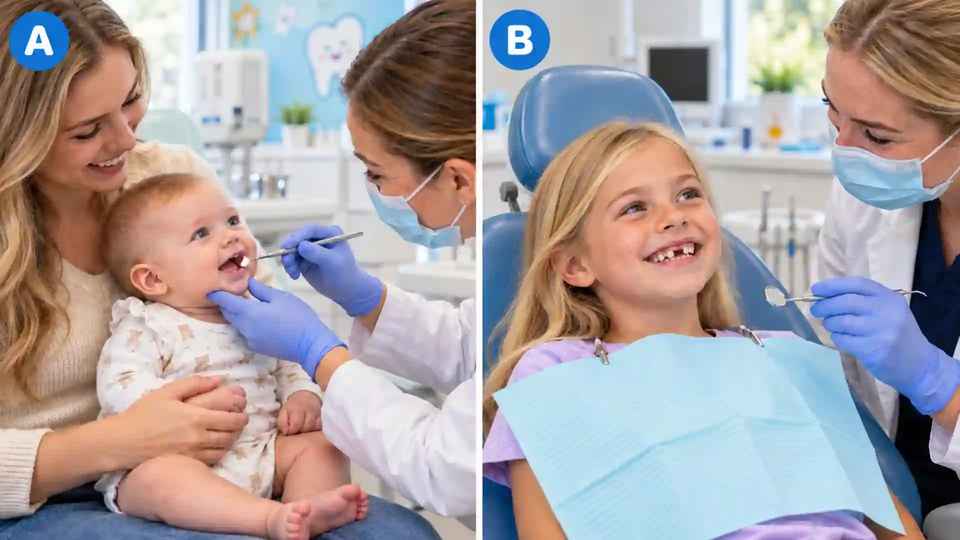
When Should a Baby First See a Dentist? A Guide to the First Dental Visit
The correct quiz answer is A: When the first tooth appears, or by age one. The American Dental Association (ADA) and the American Academy of Pediatric Dentistry (AAPD) recommend scheduling a baby's first dental visit within six months after the first tooth erupts and no later than the first birthday.
Key Takeaways:
Schedule the first dental visit within six months after the first tooth appears and by the first birthday.
Do not wait until all baby teeth emerge or begin falling out.
An infant dental exam typically includes checking the teeth, gums, jaw, and oral development.
The dentist can explain brushing, fluoride, feeding habits, and cavity prevention.
A pediatric dentist or a family dentist experienced in treating infants may provide appropriate care.
The cost of the visit depends on the provider, location, insurance coverage, and services performed.
Early dental visits help establish a dental home and support preventive care.
This guide explains when to schedule your baby's first dental visit, what happens during the appointment, how to prepare, and how to protect baby teeth at home.
Medical information notice: This article provides general educational information and does not replace individualized examination, diagnosis, or treatment from a licensed dental professional.
Quiz Answer: When Should a Baby First Visit the Dentist?
A baby's first dental visit should take place within six months after the first tooth appears and no later than the first birthday. The ADA and AAPD recommend this early appointment even if the baby has only one or two teeth.
Waiting until a child loses baby teeth is too late for the recommended first visit. Baby teeth can develop cavities soon after they emerge, and early dental care helps parents learn how to clean new teeth and reduce the risk of tooth decay.
The first visit also gives the dentist an opportunity to assess oral development, discuss feeding habits and fluoride, and establish a preventive care plan. Parents do not need to wait until their baby has a full set of teeth before scheduling an appointment.
When Is the Right Time to Schedule a Baby's First Dental Visit?
The recommended timing for a baby's first dental visit is within six months after the first tooth erupts and no later than the first birthday. This recommendation means that parents can arrange an appointment as soon as the first tooth appears rather than waiting for additional teeth.
Baby teeth can develop cavities soon after they emerge. An early appointment helps parents understand how to clean new teeth, recognize possible warning signs, and reduce the risk of early childhood tooth decay.
The visit also allows the dentist to discuss feeding habits, fluoride exposure, pacifier use, and other factors that may influence infant oral health.
If your baby reaches the first birthday without an erupted tooth, schedule a dental appointment rather than waiting indefinitely. The timing of the first tooth varies, and a dentist can assess oral development and discuss whether further evaluation is appropriate.
References:
American Dental Association (ADA), MouthHealthy — Your Baby's First Dental Visit: https://www.mouthhealthy.org/life-stages/babies-and-kids/first-dental-visit-for-baby
American Academy of Pediatric Dentistry (AAPD) — Frequently Asked Questions: https://www.aapd.org/resources/parent/faq/.
Why Is an Early Dental Visit Important?
A baby's first dental appointment focuses on prevention, oral development, and parent education rather than simply looking for cavities.
Detecting potential problems early: The dentist checks for visible signs of tooth decay, unusual tooth development, oral injuries, and abnormalities involving the gums or other oral tissues. Untreated decay in baby teeth may cause pain, interfere with eating, and require more extensive treatment.
Learning how to care for baby teeth: Parents perform most of the oral hygiene work during infancy. A dentist can demonstrate brushing technique, explain the appropriate amount of fluoride toothpaste, and suggest ways to make cleaning part of the daily routine.
Establishing a preventive care plan: The dentist may assess cavity risk by considering feeding patterns, fluoride exposure, oral hygiene, previous dental problems, and relevant medical or family history. Based on the findings, the dentist can recommend an appropriate recall schedule and discuss preventive measures such as fluoride varnish when indicated.
Early visits help establish a dental home, meaning an ongoing relationship with a dental provider who can coordinate preventive care, monitor development, and address problems as they arise.
Should You Choose a Pediatric Dentist or a Family Dentist?
Both a pediatric dentist and a general or family dentist may provide appropriate care for an infant. The right choice depends on the provider's experience with young children, the baby's needs, accessibility, and insurance coverage.
A pediatric dentist has additional specialty training focused on children's oral health. A general or family dentist has general dental training, but experience treating infants varies between practices.
When looking for a dentist who treats infants, check your insurance directory, confirm that the office accepts babies around your child's age, and ask whether infant dental examinations and preventive counseling are available. You can also ask about appointment costs, follow-up recommendations, and whether the office can accommodate your baby's feeding schedule and caregiver needs.
If your baby has a medical condition, developmental concern, or special healthcare need, tell the dental office before booking. The dental team can explain whether the practice can provide appropriate care or whether a specialist is advisable.
What Happens During a Baby's First Dental Visit?
A baby's first dental visit is generally brief and focuses on examining the mouth, assessing development, and educating parents. The exact appointment varies according to the child's age, number of teeth, medical history, and oral health findings.
Reviewing medical history and feeding habits: The dental team may ask about the baby's general health, medications, feeding routine, fluoride exposure, teething, and family history of dental problems. Questions about bottle use, pacifiers, brushing, and gum changes may also be included.
Examining the teeth and gums: The dentist checks erupted teeth for signs of decay, discoloration, damage, and developmental concerns. The examination may also include the gums, tongue, jaw, bite, and other visible oral tissues. For a very young child, the dentist may position the baby on the parent's lap to make the examination easier.
Discussing fluoride and cavity prevention: The dentist may explain how fluoride toothpaste helps prevent cavities and whether professional fluoride varnish is appropriate. Recommendations depend on the baby's age, tooth development, cavity risk, and existing fluoride exposure.
Creating a home care plan: The dentist may demonstrate how to clean the baby's teeth, discuss feeding practices, and explain what to watch for as new teeth emerge. Dental X-rays are not automatically necessary at the first appointment; imaging is determined by individual clinical needs.
How Should You Prepare for Your Baby's First Dental Appointment?
A little preparation can make the appointment easier for both the baby and caregiver.
Confirm the appointment time and whether medical history forms need to be completed in advance. Bring your baby's insurance information, relevant medical information, and a list of medications, allergies, health conditions, or feeding concerns. Write down questions about teething, brushing, fluoride, pacifiers, and bottle use.
When practical, schedule the visit at a time when your baby is usually rested and alert rather than during a regular nap or feeding time. A familiar blanket, pacifier, or comfort item may help the baby feel more secure.
You do not need to make your baby sit still or practice a perfect dental examination at home. The dental team is accustomed to working with infants who move, fuss, or cry.
What If Your Baby Cries During the Dental Exam?
Crying during a first dental visit is common and does not mean the appointment has failed. Infants may be unfamiliar with the environment, the bright lights, or the sensation of having their mouths examined.
The dentist may use a gentle approach, allow the parent to hold the baby, and adapt the examination to the child's comfort and developmental stage. Parents can help by remaining calm, bringing a familiar comfort item, and following the dental team's instructions.
If the examination cannot be completed fully, the dentist can explain what was accomplished and whether another appointment is needed. The purpose of the first visit is to begin preventive care and establish a positive relationship with the dental team, not to require the baby to cooperate perfectly.
How Much Does a Baby's First Dental Visit Cost?
The cost of a baby's first dental visit depends on the dental practice, geographic location, insurance coverage, and services provided. There is no single price that accurately represents every infant dental appointment.
A basic examination may have a different fee from a visit that includes additional preventive procedures, diagnostic imaging when indicated, or treatment for an identified dental problem. Before the appointment, request an estimate and ask which services are included.
Many dental plans include preventive services for children, but coverage, frequency limits, and cost-sharing rules vary. Check whether your plan covers an infant dental examination, preventive counseling, and any recommended fluoride treatment. Ask whether the office is in-network and whether additional services may involve separate charges.
Children enrolled in Medicaid are entitled to dental benefits under the federal Early and Periodic Screening, Diagnostic, and Treatment benefit. Separate Children's Health Insurance Program (CHIP) plans must also include dental coverage, although specific benefits and arrangements vary.
If your family does not have dental insurance, ask the dental office about self-pay fees, payment options, community health centers, or local programs that provide pediatric dental care.
Reference: Centers for Medicare & Medicaid Services (CMS) — Dental Care: https://www.medicaid.gov/medicaid/benefits/dental-care.
How Can You Protect Your Baby's Teeth Before and After the First Visit?
Infant oral health begins before the first tooth appears. A simple daily routine helps keep the mouth clean, supports healthy habits, and makes the transition to brushing easier.
Before the first tooth appears, gently wipe your baby's gums with a clean, damp, soft cloth or gauze. Toothpaste is not needed for toothless gums.
As soon as the first tooth appears, start brushing with a soft, small-headed toothbrush and an age-appropriate amount of fluoride toothpaste. The American Academy of Pediatric Dentistry recommends a smear approximately the size of a grain of rice for children younger than three. Brush twice daily, including before bedtime. For children younger than two, the CDC advises consulting a dentist or doctor about fluoride toothpaste use.
Parents should perform or closely assist with brushing because infants cannot clean their own teeth effectively.
Avoid putting your baby to bed with a bottle containing formula, milk, juice, or other sugary drinks. Do not dip pacifiers in honey, syrup, or sugar. Discuss feeding routines with your pediatrician and dentist if you are unsure how to balance nutritional needs with cavity prevention.
A dentist or other qualified healthcare professional may recommend fluoride varnish after teeth emerge, depending on the child's age and cavity risk.
What Warning Signs Should Parents Watch For?
Although many oral changes during infancy are part of normal development, some symptoms warrant professional evaluation.
Contact a dentist if you notice white, brown, or dark areas on an erupted tooth; persistent gum swelling or unusual bleeding; a chipped, broken, or injured tooth; signs of discomfort that interfere with feeding; or an oral lesion that does not improve.
Seek prompt professional advice if your baby develops facial swelling, significant oral pain, or signs of infection. If your baby has difficulty breathing or swallowing, seek emergency medical care.
Teething may cause gum tenderness, drooling, and a desire to chew on objects. However, significant fever, severe illness, or persistent feeding difficulty should not automatically be attributed to teething.
Frequently Asked Questions About a Baby's First Dental Visit
When should a baby first visit the dentist?
Schedule the first dental visit within six months after the first tooth appears and no later than the first birthday.
Should I wait until my baby has more teeth?
No. One tooth is enough reason to arrange an appointment. Early visits help parents learn how to care for emerging teeth and reduce the risk of tooth decay.
What if my baby has no teeth at 12 months?
Schedule a dental appointment to assess oral development and discuss whether further evaluation is appropriate.
Is a pediatric dentist necessary for the first visit?
Not always. A pediatric dentist has additional specialty training in children's oral health, but a general or family dentist experienced in treating infants may also provide appropriate care.
Will my baby need X-rays at the first appointment?
Not necessarily. X-rays are used when clinically indicated, based on the baby's individual needs.
How much does a baby's first dental visit cost?
Costs vary by provider, location, insurance coverage, and the services performed. Ask the office for an estimate before the appointment.
What if I cannot afford my baby's first dental visit?
Ask about self-pay fees, payment arrangements, community health centers, and participating Medicaid or CHIP providers. Eligible families may be able to obtain dental services through public coverage or community programs.
Sources
- American Dental Association (ADA), MouthHealthy. Your Baby's First Dental Visit. https://www.mouthhealthy.org/life-stages/babies-and-kids/first-dental-visit-for-baby
- American Academy of Pediatric Dentistry (AAPD). Frequently Asked Questions. https://www.aapd.org/resources/parent/faq/
- Centers for Disease Control and Prevention (CDC). Oral Health Tips for Children. https://www.cdc.gov/oral-health/prevention/oral-health-tips-for-children.html
- Health Resources and Services Administration (HRSA). Oral Health for Young Children. https://www.hrsa.gov/oral-health/young-children
- Centers for Medicare & Medicaid Services (CMS). Dental Care. https://www.medicaid.gov/medicaid/benefits/dental-care