How Much Fluoride Toothpaste Should a Child Under 3 Use?
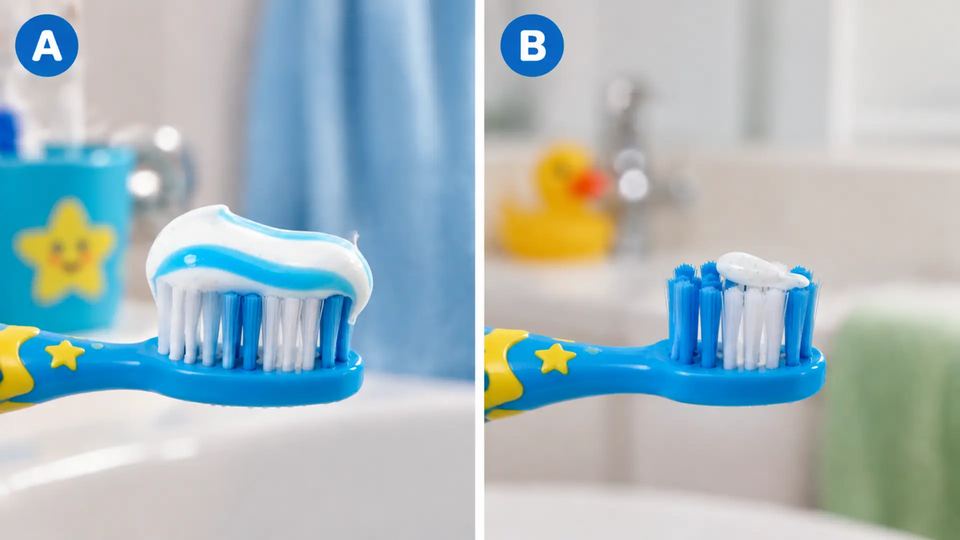
The correct quiz answer is B: A rice-sized smear. Children younger than three should use a thin smear of fluoride toothpaste no larger than a grain of rice, according to the American Dental Association (ADA), American Academy of Pediatric Dentistry (AAPD), and American Academy of Pediatrics (AAP).
Key Takeaways:
Children younger than three should use no more than a rice-sized smear of fluoride toothpaste.
Brushing should begin when the first tooth appears and take place twice daily.
An adult should dispense the toothpaste and supervise brushing.
Using the recommended amount helps prevent cavities while limiting unnecessary fluoride ingestion.
For children younger than two, the CDC advises consulting a dentist or doctor before introducing fluoride toothpaste.
Professional fluoride varnish is recommended for children younger than five beginning when their primary teeth erupt, with repeat applications guided by clinical recommendations and individual circumstances.
This guide explains the recommended toothpaste amount, why toddlers need less toothpaste than older children, and how adults can help protect young children's teeth.
Medical information notice: This article provides general educational information and does not replace individualized examination, diagnosis, or treatment from a licensed dental professional.
Quiz Answer: How Much Fluoride Toothpaste Should Children Under Three Use?
A rice-sized smear is the correct answer. For children younger than three, the ADA, AAPD, and AAP recommend a thin amount of fluoride toothpaste no larger than a grain of rice.
A full strip is more toothpaste than recommended for this age group. Young children are more likely to swallow toothpaste because they have not yet learned to spit reliably. Using more toothpaste does not automatically provide better cavity protection and can increase the amount swallowed.
An adult should dispense the toothpaste and perform or directly assist with brushing twice daily. For children younger than two, the CDC advises consulting a dentist or doctor before introducing fluoride toothpaste.
How Much Fluoride Toothpaste Should a Child Under 3 Use?
For children younger than three, the ADA, AAPD, and AAP recommend a smear of fluoride toothpaste no larger than a grain of rice. The toothpaste should form a thin, narrow streak across the toothbrush bristles rather than a rounded blob.
This recommendation applies from the eruption of the first tooth until the child's third birthday under these professional guidelines.
Before the first tooth appears, caregivers can gently clean the gums with a soft, clean cloth or infant toothbrush and water. From the first tooth until age three, use a rice-sized smear when fluoride toothpaste has been recommended for the child. For children ages three through six, standard U.S. dental guidance recommends no more than a pea-sized amount.
The ADA's fluoride guidance and the AAP's parent guidance explain age-based toothpaste amounts:
https://www.ada.org/resources/ada-library/oral-health-topics/fluoride-topical-and-systemic-supplements
https://www.healthychildren.org/English/healthy-living/oral-health/Pages/FAQ-Fluoride-and-Children.aspx
What Does a Rice-Sized Toothpaste Amount Look Like?
A rice-sized toothpaste amount is a small, thin smear, not a full brush of toothpaste.
Correct: A narrow smear approximately the size of a grain of rice.
Too much: A thick strip covering most of the toothbrush head.
Too much: A rounded dollop approaching the size of a pea.
The goal is to use no more than a rice-sized smear, not to cover the toothbrush head with toothpaste. The exact appearance depends on the toothbrush head and toothpaste consistency.
An adult should dispense the toothpaste because toddlers do not yet have the judgment or coordination needed to control the amount reliably. Keep the tube out of reach between brushing sessions.
Why Do Toddlers Need Less Toothpaste Than Older Children?
Toddlers need less toothpaste primarily because they are more likely to swallow it instead of spitting it out.
Fluoride strengthens tooth enamel and helps reduce the risk of cavities. It also supports remineralization, the process through which minerals are restored to weakened enamel.
However, repeatedly swallowing more fluoride toothpaste than recommended can increase fluoride exposure while teeth are developing. Excessive fluoride ingestion during this period can contribute to dental fluorosis, which may appear as faint white lines, spots, or other changes in developing enamel.
The recommended rice-sized toothpaste amount balances these considerations: it provides fluoride for cavity prevention while limiting the quantity available to be swallowed.
Using a pea-sized amount on a toddler's toothbrush is unnecessary under the standard recommendation for children younger than three.
Does Using Less Toothpaste Mean Less Cavity Protection?
Not necessarily. The recommended amount is designed for young children, whose ability to spit reliably is still developing.
Consistent brushing technique and frequency matter alongside the amount used. A rice-sized smear of fluoride toothpaste used correctly twice daily can help protect toddler teeth.
Using more toothpaste does not automatically provide better protection. It can instead increase the amount a child swallows.
For additional information about fluoride's role in protecting enamel, see the National Institute of Dental and Craniofacial Research (NIDCR): https://www.nidcr.nih.gov/health-info/fluoride.
When Should a Child Start Using Fluoride Toothpaste?
The ADA, AAPD, and AAP recommend beginning fluoride toothpaste when the first tooth appears, rather than waiting until a child has several teeth.
Baby teeth are susceptible to decay soon after eruption. Early cavity prevention helps protect primary teeth, which support chewing, speech development, and the spacing needed for permanent teeth.
However, U.S. public health guidance is not phrased identically for children younger than two. The CDC advises consulting a dentist or doctor before introducing fluoride toothpaste to children in this age group. The NIDCR also provides guidance for parents on children's fluoride use.
If your child is younger than two, discuss fluoride toothpaste use with your child's dentist or pediatrician and follow individualized guidance. This is especially important if your child has an elevated cavity risk or receives fluoride from several sources.
Once fluoride toothpaste is recommended for your child, use the age-appropriate amount and supervise every brushing session.
How Should You Brush a Toddler's Teeth With Fluoride Toothpaste?
The most reliable approach is for an adult to perform or directly assist with brushing. Toddlers generally cannot clean every tooth surface thoroughly on their own.
Step 1: Choose an age-appropriate toothbrush. Select a toothbrush with a small head and soft bristles designed for babies or toddlers.
Step 2: Dispense the toothpaste yourself. Apply a rice-sized smear of fluoride toothpaste to the bristles. Keep the tube out of your child's reach.
Step 3: Position your child comfortably. Choose a position that allows you to see the teeth clearly and support your child's head.
Step 4: Brush every tooth surface. Use small, gentle movements to clean the front, back, and chewing surfaces of the teeth. Pay attention to the gumline and the back teeth.
Step 5: Encourage spitting when developmentally appropriate. Toddlers may not understand how to spit reliably. Encourage the behavior when your child is ready, but do not assume that a young child can consistently avoid swallowing toothpaste.
Step 6: Repeat before bedtime. Brush twice daily, including the final brushing before sleep. After bedtime brushing, avoid giving sugary foods or drinks.
The ADA's toothbrush guidance provides additional advice on children's brushing and adult supervision: https://www.ada.org/resources/ada-library/oral-health-topics/toothbrushes.
Which Fluoride Toothpaste Is Best for Toddlers?
For most toddlers who have been advised to use fluoride toothpaste, choose a product formulated for daily cavity prevention and use the recommended amount.
The label matters more than whether the package features a cartoon character or uses the words 'baby' or 'toddler.'
Consider the following when selecting children's fluoride toothpaste:
Fluoride content: Choose toothpaste containing fluoride appropriate for routine cavity prevention.
ADA Seal of Acceptance: Look for the seal when available; it identifies products that meet the ADA's applicable acceptance criteria.
Age suitability: Follow the product label and your child's dentist's advice.
Flavor: Choose a flavor your child tolerates to help make consistent brushing easier.
Packaging: Store the tube securely out of reach to prevent unsupervised use or accidental ingestion.
Product purpose: Prefer a straightforward anticavity toothpaste; whitening or other specialty features are generally unnecessary for toddler cavity prevention.
Many U.S. fluoride toothpastes contain sodium fluoride, sodium monofluorophosphate, or stannous fluoride. Select an appropriate product according to its label and your child's individual needs.
Is Fluoride-Free Toddler Toothpaste a Good Substitute?
Fluoride-free toothpaste can help clean teeth, but it does not provide the same fluoride-related protection against cavities.
If your goal is cavity prevention, discuss an appropriate fluoride toothpaste with your child's dentist rather than assuming a fluoride-free training toothpaste provides equivalent protection.
The dentist can help you weigh the benefits of fluoride against your child's age, cavity risk, and other sources of fluoride.
For additional product-selection guidance, read Best Fluoride Toothpaste for Cavity Prevention: /best-fluoride-toothpaste-cavity-prevention/.
What Should You Do If Your Toddler Swallows Toothpaste?
Young children commonly swallow some toothpaste because they have not mastered spitting. The recommended rice-sized amount helps limit the quantity available to be swallowed.
A small accidental swallow during ordinary brushing is different from eating a large amount of toothpaste directly from the tube.
If your child swallows more than the normal brushing amount, assess how much may be missing and contact a healthcare professional or Poison Control for advice. In the United States, Poison Control is available at 1-800-222-1222.
Poison Control's toothpaste ingestion guide explains what to do after accidental ingestion and how to get case-specific guidance: https://www.poison.org/articles/toothpaste. You can also use the webPOISONCONTROL online tool: https://triage.webpoisoncontrol.org/.
Do not induce vomiting. If your child develops severe symptoms or has difficulty breathing, seek emergency medical care.
To reduce accidental ingestion, dispense the toothpaste yourself, keep the tube out of reach, use only the recommended smear, supervise brushing from beginning to end, and do not allow a toddler to suck toothpaste directly from the tube.
Does Swallowing Toothpaste Cause Dental Fluorosis?
Repeatedly swallowing more fluoride than recommended while teeth are developing can increase the risk of dental fluorosis.
Dental fluorosis affects the appearance of enamel and may cause white lines or spots. Its severity varies, and mild forms may be difficult to notice.
Using the recommended amount and preventing unsupervised ingestion helps reduce unnecessary exposure. Parents should not respond to fluorosis concerns by automatically eliminating fluoride toothpaste; instead, discuss the appropriate preventive approach with the child's dentist or pediatrician.
The CDC's dental fluorosis guidance explains the relationship between excessive fluoride ingestion during tooth development and changes in enamel appearance: https://www.cdc.gov/oral-health/about/about-dental-fluorosis.html.
What Is the Difference Between Fluoride Toothpaste and Fluoride Treatment for Kids?
Fluoride toothpaste and professional fluoride treatment are different preventive services.
Fluoride toothpaste is used at home to deliver fluoride during daily brushing. Professional fluoride treatment for kids is applied by a dental professional or another appropriately trained provider when indicated, often as fluoride varnish during a healthcare visit.
Professional fluoride varnish is recommended as a preventive measure for young children beginning when their primary teeth erupt.
The U.S. Preventive Services Task Force (USPSTF) recommends fluoride varnish for all children younger than five, while the timing of repeat applications should follow clinical guidance and individual circumstances.
The USPSTF recommendation applies to primary care clinicians and supports preventive care beginning early in childhood. The appropriate frequency of repeat applications should be guided by clinical recommendations and the child's circumstances rather than assuming that all children need an identical schedule.
Read the USPSTF recommendation on preventing dental caries in children younger than five: https://www.uspreventiveservicestaskforce.org/uspstf/recommendation/prevention-of-dental-caries-in-children-younger-than-age-5-years-screening-and-interventions1.
How Does Cavity Prevention Fit Into Children's Dental Care?
Cavity prevention for toddlers involves more than choosing the correct toothpaste amount. Brushing, diet, fluoride exposure, and early dental visits work together to protect baby teeth.
Schedule the first dental visit early. The ADA and AAPD recommend that a child establish a dental home when the first tooth appears and no later than the first birthday.
Limit frequent exposure to sugary foods and drinks. Bacteria in dental plaque can use sugars to produce acids that weaken enamel. Try to limit frequent sugary snacks and drinks, especially between meals and after bedtime brushing.
Check your child's water source. Community water fluoridation provides another source of fluoride for cavity prevention. Fluoride levels vary by water source, so parents using private wells or certain bottled waters may need additional guidance.
Understand what toothpaste cannot treat. Fluoride toothpaste helps prevent cavities and supports enamel health, but it cannot replace a child's dental examination or independently treat a cavity that has already formed. If you notice white, brown, or dark spots on your child's teeth, arrange a dental assessment.
How Can You Decide What Your Child Needs?
Use your child's age and circumstances to identify a sensible next step.
Before the first tooth appears: Clean the gums gently and ask the pediatrician or dentist about age-appropriate oral care.
First tooth has appeared and the child is younger than two: Discuss fluoride toothpaste use with the child's dentist or doctor, following CDC and NIDCR guidance.
Child is two and has erupted teeth: Use a rice-sized smear of fluoride toothpaste and brush twice daily with adult assistance, unless the child's clinician recommends a different approach.
Child is approaching age three: Continue the rice-sized amount until age three under standard ADA, AAPD, and AAP guidance.
Child has turned three: Discuss the transition to a pea-sized amount and continue adult supervision.
Child repeatedly swallows toothpaste: Dispense the amount yourself, supervise closely, and ask the dentist for practical brushing guidance.
Child has white, brown, or dark spots on a tooth: Arrange a dental examination rather than diagnosing decay at home.
Child has tooth pain, swelling, or signs of infection: Contact a dentist promptly; seek urgent care for facial swelling with fever or difficulty swallowing or breathing.
Common Mistakes to Avoid
Using a pea-sized amount before age three: The standard recommendation for children younger than three is a rice-sized smear.
Letting the child dispense toothpaste: Toddlers may squeeze out much more than intended or swallow toothpaste directly.
Choosing fluoride-free toothpaste without considering cavity risk: Fluoride-free products do not provide equivalent fluoride-related cavity protection.
Assuming toothpaste replaces dental visits: Home brushing does not identify every early lesion or replace professional assessment.
Adding fluoride supplements without advice: A child's water source and total fluoride exposure must be considered.
Using fluoride mouth rinse without professional advice: Young children may swallow mouth rinse, so it is not a routine substitute for toothpaste.
Frequently Asked Questions About Fluoride Toothpaste for Toddlers
How much fluoride toothpaste should children under three use?
Children younger than three should use a thin smear no larger than a grain of rice, following the child's clinician's guidance.
Is a grain-of-rice amount of fluoride toothpaste enough for a toddler?
Yes. A smear no larger than a grain of rice is the standard recommendation for children younger than three under ADA, AAPD, and AAP guidance. Use it twice daily when fluoride toothpaste has been recommended for your child.
Should a one-year-old use fluoride toothpaste?
The ADA, AAPD, and AAP recommend a rice-sized smear from the first tooth. The CDC advises consulting a dentist or doctor before using fluoride toothpaste in children younger than two. Discuss the appropriate approach with your child's healthcare professional.
What should I do if my toddler swallows toothpaste?
Use only the recommended amount and supervise brushing. If your child swallows substantially more than the normal brushing amount, contact Poison Control at 1-800-222-1222 or use the webPOISONCONTROL online tool: https://triage.webpoisoncontrol.org/.
Does every toddler need professional fluoride varnish?
The USPSTF recommends fluoride varnish for all children younger than five beginning when their primary teeth erupt. The appropriate timing of repeat applications should follow clinical guidance and individual circumstances.
Is fluoride-free toddler toothpaste better?
Not necessarily. Fluoride-free toothpaste can clean teeth, but it does not provide the same fluoride-related protection against cavities. Ask your child's dentist which product is appropriate for your child's age and risk level.
When should my toddler first see a dentist?
The ADA and AAPD recommend a first dental visit when the first tooth appears and no later than the first birthday. The visit helps assess oral development, identify early problems, and establish an appropriate preventive care plan.
Sources
- American Dental Association (ADA). Fluoride: Topical and Systemic Supplements. https://www.ada.org/resources/ada-library/oral-health-topics/fluoride-topical-and-systemic-supplements
- American Dental Association (ADA). Toothbrushes. https://www.ada.org/resources/ada-library/oral-health-topics/toothbrushes
- American Dental Association (ADA). Fluoride Toothpaste Use for Young Children Clinical Practice Guideline. https://www.ada.org/resources/research/science/evidence-based-dental-research/fluoride-toothpaste-for-young-children-guideline/
- American Academy of Pediatrics (AAP). Fluoride for Children: Parent FAQs. https://www.healthychildren.org/English/healthy-living/oral-health/Pages/FAQ-Fluoride-and-Children.aspx
- American Academy of Pediatric Dentistry (AAPD). Parent FAQ. https://www.aapd.org/resources/parent/faq/
- U.S. Preventive Services Task Force (USPSTF). Prevention of Dental Caries in Children Younger Than 5 Years. https://www.uspreventiveservicestaskforce.org/uspstf/recommendation/prevention-of-dental-caries-in-children-younger-than-age-5-years-screening-and-interventions1
- Centers for Disease Control and Prevention (CDC). About Fluoride. https://www.cdc.gov/oral-health/prevention/about-fluoride.html
- Centers for Disease Control and Prevention (CDC). About Dental Fluorosis. https://www.cdc.gov/oral-health/about/about-dental-fluorosis.html
- National Institute of Dental and Craniofacial Research (NIDCR). Fluoride and Dental Health. https://www.nidcr.nih.gov/health-info/fluoride
- National Institute of Dental and Craniofacial Research (NIDCR). Oral Hygiene. https://www.nidcr.nih.gov/health-info/oral-hygiene
- Poison Control. Toothpaste Ingestion Guide. https://www.poison.org/articles/toothpaste
- webPOISONCONTROL. Online Poison Exposure Assessment Tool. https://triage.webpoisoncontrol.org/